
Microeconomics
Consumer choice, demand, production, costs, market structures, game theory, welfare and market failure. Work through the assumptions before the calculation.
UNDERGRADUATE & ADVANCED ECONOMICS
Divine School of Economics offers live online 1:1 tutoring for university students in Microeconomics, Macroeconomics, Econometrics, Mathematical Economics and Statistics. Work with Akshay Kumar on your module’s concepts, derivations, problem sets and examination preparation, with support matched to your syllabus and starting point.
Assistant Professor, ISBF · Delhi School of Economics postgraduate · Undergraduate Economics Gold Medalist
Your first 1:1 lesson is completely free. Share your university, module and time zone so we can discuss the support you need and arrange a suitable lesson time.
In Dubai or elsewhere in the UAE? Share preferred lesson times in Gulf Standard Time (GST, UTC+4); availability is confirmed individually.
A global live tutoring school for University and A-Level Economics.
01 / COURSE COVERAGE
Support is planned around your actual module. The topics below show the main areas we can discuss, rather than a single fixed university syllabus.
Consumer choice, demand, production, costs, market structures, game theory, welfare and market failure. Work through the assumptions before the calculation.
National income, consumption and investment, short-run models, inflation, monetary and fiscal policy, growth and open-economy reasoning.
Functions, calculus, optimisation, matrices and comparative statics. Connect each mathematical step to the economic question it answers.
Probability, distributions, estimation and hypothesis testing. Understand the meaning of a result as well as the procedure used to obtain it.
Read the Statistics explanation and confidence-interval example
OLS, multiple regression, interpretation, inference and common modelling problems. Explain what a coefficient means and what the evidence can support.
Discuss postgraduate theory, quantitative methods or a more demanding module using your current syllabus and reading list.
UNIVERSITY MICROECONOMICS
Microeconomics starts with a decision: who is choosing, what is their objective, and which constraints do they face? In consumer theory, preferences and a budget determine feasible choices. An interior tangency between an indifference curve and a budget line is a candidate solution under appropriate assumptions; boundaries and corner solutions must also be checked.
For firms, distinguish revenue from profit and marginal cost from average cost. A competitive firm takes the market price as given, while a monopolist faces a downward-sloping demand curve and recognises that selling more can change the price received. Conditions such as marginal revenue equals marginal cost need a feasibility and optimality check before they can be interpreted as profit maximisation.
Lessons can also connect production and cost, market structures, game theory, welfare and market failure. In a game, a Nash equilibrium consists of mutual best responses; it need not maximise the players’ joint payoff. In welfare analysis, a private optimum need not be socially efficient when external effects or other market failures are present. We work from your module’s assumptions, notation and questions.
Explore the mathematical methods behind optimisationAN ORIGINAL WORKED PROBLEM
Original illustrative problem. A single-product monopolist chooses output q. Inverse demand is p(q) = 60 − 2q and total cost is TC(q) = 20 + 12q + q². Quantities are divisible; output and price must be non-negative, so 0 ≤ q ≤ 30. All money amounts use the same illustrative currency unit.
Find the profit-maximising output, the price charged and total profit. Check that the solution is a maximum.
Total revenue is price multiplied by quantity. Subtract total cost to obtain profit.
TR(q) = 60q − 2q²; π(q) = 48q − 3q² − 20
Differentiate profit and set its derivative to zero. This gives the interior candidate.
dπ/dq = 48 − 6q = 0 ⇒ q* = 8
Output 8 lies in the feasible interval. Profit is strictly concave throughout that interval, so its stationary point is the unique global maximum.
d²π/dq² = −6 < 0; 0 < 8 < 30
Use demand to find price, then calculate revenue and cost at the chosen output.
p* = 60 − 2(8) = 44; TR = 352; TC = 180; π* = 172
At the optimum, marginal revenue equals marginal cost. Price exceeds both because expanding output along a downward-sloping demand curve lowers revenue received on existing units as well as adding sales.
MR(8) = 60 − 4(8) = 28 = MC(8) = 12 + 2(8)
The firm chooses quantity using marginal revenue and marginal cost, then reads price from demand. Setting price equal to marginal cost would describe a different decision rule. The result is conditional on the demand and cost functions given here; it is not a prediction for an actual firm.
UNIVERSITY MACROECONOMICS
A useful starting point for short-run Macroeconomics is the Keynesian expenditure model. It asks which level of output makes planned spending equal to production. In a closed economy with government, planned expenditure is consumption plus investment plus government purchases. Consumption can depend on disposable income, so output and spending are determined together.
If planned expenditure exceeds current output, firms can meet sales by running down inventories. Under the model’s adjustment story, they then have an incentive to increase production. Higher production creates income, which induces further consumption. The marginal propensity to consume measures the share of an extra unit of disposable income spent on consumption; the remainder leaks into saving in this simple model.
The fixed-price model assumes that output can adjust when resources are underused. It holds investment and lump-sum taxes fixed in the example below and leaves out imports and interest-rate responses. Your university may extend this framework through proportional taxes, an open economy, IS–LM, aggregate demand and supply, or other models. We make the additional assumptions explicit rather than applying one multiplier to every situation.
Discuss the model used in your university moduleAN ORIGINAL WORKED PROBLEM
Original illustrative fixed-price, closed-economy model. C = 100 + 0.75(Y − T), I = 80, G = 120 and lump-sum taxes T = 80. Investment and taxes are exogenous. Output can respond to demand; there is no import leakage or interest-rate feedback. All spending and income figures refer to the same period and units.
Find equilibrium income. Then calculate the effect of increasing G by 20 while keeping the other assumptions and parameters unchanged.
Substitute the tax, investment and government-purchase values into the goods-market equilibrium condition.
Y = C + I + G = 100 + 0.75(Y − 80) + 80 + 120
Collect income-dependent spending on the left. Check the answer by recovering consumption.
Y = 240 + 0.75Y ⇒ 0.25Y = 240 ⇒ Y* = 960; C = 760
Government purchases rise from 120 to 140. Autonomous planned expenditure rises from 240 to 260.
Y′ = 260 + 0.75Y′ ⇒ Y′ = 1,040; ΔY = 80
The initial extra spending of 20 creates income. Further rounds of induced consumption are progressively smaller because only 75% of each extra unit of income is spent.
ΔY/ΔG = 1/(1 − 0.75) = 4; 20 + 15 + 11.25 + … = 80
Income rises by 80 in this model because government purchases increase without an accompanying tax increase and induced consumption adds further demand. A balanced-budget change or a response of imports, investment or prices would require a different calculation. The equilibrium comparison does not specify how long adjustment takes.
STATISTICS FOR ECONOMICS
Statistics connects a question about a population with information from a sample. A population mean is a parameter; a sample mean is a statistic that changes across samples. Before choosing a formula, identify the target population, how observations were sampled, what is being estimated and which assumptions support the calculation.
The standard deviation describes variation between observations. The standard error of a sample mean describes its sampling uncertainty. For independent observations with common finite variance σ², that standard error is σ/√n; when σ is unknown, the method must account for estimating it. A larger sample can reduce sampling uncertainty, but it does not automatically remove selection bias or a poorly defined population.
Confidence intervals and hypothesis tests should be explained in the context of the question. Statistical significance is not the same as economic importance, and an observed association does not by itself establish causation. Lessons can cover probability, conditional probability, distributions, estimation and testing, with the particular method matched to your module.
Connect statistical inference with EconometricsAN ORIGINAL WORKED PROBLEM
Original illustrative problem. An independent random sample of n = 64 households has mean weekly expenditure x̄ = £520. Assume a normal population with a known standard deviation σ = £160. These stated assumptions allow a normal z interval; an unknown population standard deviation would require a different treatment.
Construct a 95% confidence interval for the population mean weekly expenditure. Explain what the result says about a proposed population mean of £500.
Use the population standard deviation and sample size. The standard error concerns uncertainty in the estimated mean, not the spread of individual household spending.
SE(x̄) = σ/√n = 160/√64 = £20
Using the conventional normal critical value 1.96, multiply the standard error by the critical value.
Margin = 1.96 × 20 = £39.20
Add and subtract the margin from the sample mean.
£520 ± £39.20 ⇒ [£480.80, £559.20]
The interval includes £500. Under the stated model, the corresponding two-sided z test would not reject a population mean of £500 at the 5% level. This does not establish that £500 is the true mean.
z = (520 − 500)/20 = 1; |1| < 1.96
Across repeated samples under these assumptions, approximately 95% of intervals constructed this way would cover the fixed population mean. This is not an interval containing 95% of households’ spending, nor a 95% probability assigned to the fixed mean after this interval is observed. Policy interpretation also depends on the population represented and the economic importance of the spending differences.
Bring your module outline and a practice question to explore the reasoning in a free first 1:1 lesson with Akshay Kumar.
Request Your Free First 1:1 Lesson02 / WHAT WE WORK ON
Understanding is the starting point. The next step is using it independently, with clear reasoning and careful practice.
Break a difficult question into the model, the assumptions and the steps of the argument. Then practise a related question yourself.
Follow the algebra carefully and explain why each condition is needed. Build confidence with optimisation, equilibrium and comparative statics.
Translate mathematical and statistical results into clear economic language, including the limits of the conclusion.
Revisit weak areas, practise unfamiliar questions and learn to present a complete, logically ordered answer.
LESSONS BUILT AROUND YOUR STUDIES
Universities can teach the same subject with different prerequisites, notation and assessments. DSE provides independent tutoring matched to your course materials; a university name identifies your study context rather than an official DSE partnership.
Share your degree, year, exact module title, syllabus, lecture notes or reading list, and examination timing. Akshay can use these to discuss the level of support, identify prerequisites and work with the notation and assumptions your course uses. Selected advanced topics are considered from your actual outline before the scope is agreed.
Students at University of Birmingham Dubai, University of Dubai and other UAE universities can share their actual module outlines for a tutoring-fit review. Lessons are matched to the topics, notation and assessment requirements you provide. DSE offers independent tutoring and is not affiliated with these universities.
A lesson can focus on one concept, a derivation, a diagram, a suitable problem-set question or past-paper practice. Work through why each step follows, then practise applying the reasoning to a related question. Examination preparation can include interpreting the command words, showing a complete argument and checking calculations against the stated assumptions.
Use the first 1:1 lesson to discuss what you are studying, where you get stuck and what you want help with. Bring your module outline and one topic or practice question. We can work through a suitable concept or part of a problem, checking your current understanding and the steps that need more attention.
The discussion helps identify useful practice and possible next steps, and gives you a chance to ask about the teaching approach. Confirm a suitable time and joining details with Akshay beforehand. The first 1:1 lesson is free; its focus is agreed from your course and starting point.
Lessons take place live online on Zoom. Students in the UK, India, UAE, Singapore, USA, Canada, Australia and elsewhere can enquire using their own local time zone. Share your city or time-zone name, a few preferred dates and local times, and any examination deadline so that a suitable arrangement can be discussed.
Availability is confirmed for each enquiry before a lesson is booked. Check the agreed date and time in both locations, particularly when daylight-saving changes affect the time difference. The New Delhi and UK WhatsApp buttons are contact options; choosing an office does not by itself reserve a lesson time.
03 / HOW YOU CAN LEARN
Share your course, goals and starting point to discuss current fees, availability and the support that fits you.
Discuss your learning optionsFocused, pay-as-you-go 1:1 lessons for a particular concept, problem set or period of revision.
A personalised plan across a paper or course, with regular live teaching and preparation matched to your priorities.
Explore econdse for self-paced University and high-school Economics courses, detailed recorded videos and 24×7 live doubt sessions.

YOUR ECONOMICS TUTOR
Akshay Kumar is an Assistant Professor of Economics at the Indian School of Business and Finance (ISBF), a University of London Recognised Teaching Centre, where his teaching includes Mathematics and Elements of Econometrics. He holds a Master’s in Economics from the Delhi School of Economics, is an Undergraduate Gold Medalist in Economics and has seven years of teaching experience as an Assistant Professor at the University of Delhi.
Connect on LinkedInSTUDENT VOICES
Students describe their experience of learning Economics and Mathematics with Akshay Sir.
Explore all 21 student videosA student describes clear explanations, relevant notes, patient teaching and practice for an Econometrics exam.
View this student storyA University of Ottawa Economics student describes practical problem-solving and tutoring adapted to his learning needs.
View this student storyIN OUR STUDENTS’ WORDS
Read students’ experiences of Economics and Mathematics lessons, recorded courses and exam preparation.
Read all 11 student reviews“We go through and explain content and then complete exercises to make sure I would know what to do in an exam setting.”
London School of Economics (LSE)
MA107 · Quantitative Methods
Read the full feedback“concepts were taught with clarity and some practice was given”
Lahore University of Management Sciences (LUMS)
ECON-212 · Intermediate Microeconomics
Read the full feedback“The recorded lectures and lecture notes were incredibly helpful, allowing me to study at my own pace.”
Singapore Institute of Management · University of London
Econ 101
Read the full feedbackECONDSE · THE DSE LEARNING APP
Explore all our self-paced University and high-school Economics courses in econdse, with detailed recorded videos and 24×7 live doubt sessions.
Explore the app and access stepsSTART LEARNING BEFORE WE MEET
Explore DSE examination practice in Microeconomics and Statistics alongside the existing Econometrics lectures and tutorials. The DU videos retain their university, semester and paper labels so you can compare their questions with your own module.
Watch on YouTubeMicroeconomics
Macroeconomics
Mathematical Economics
Statistics & Econometrics
Work through university examination questions with Akshay Sir.
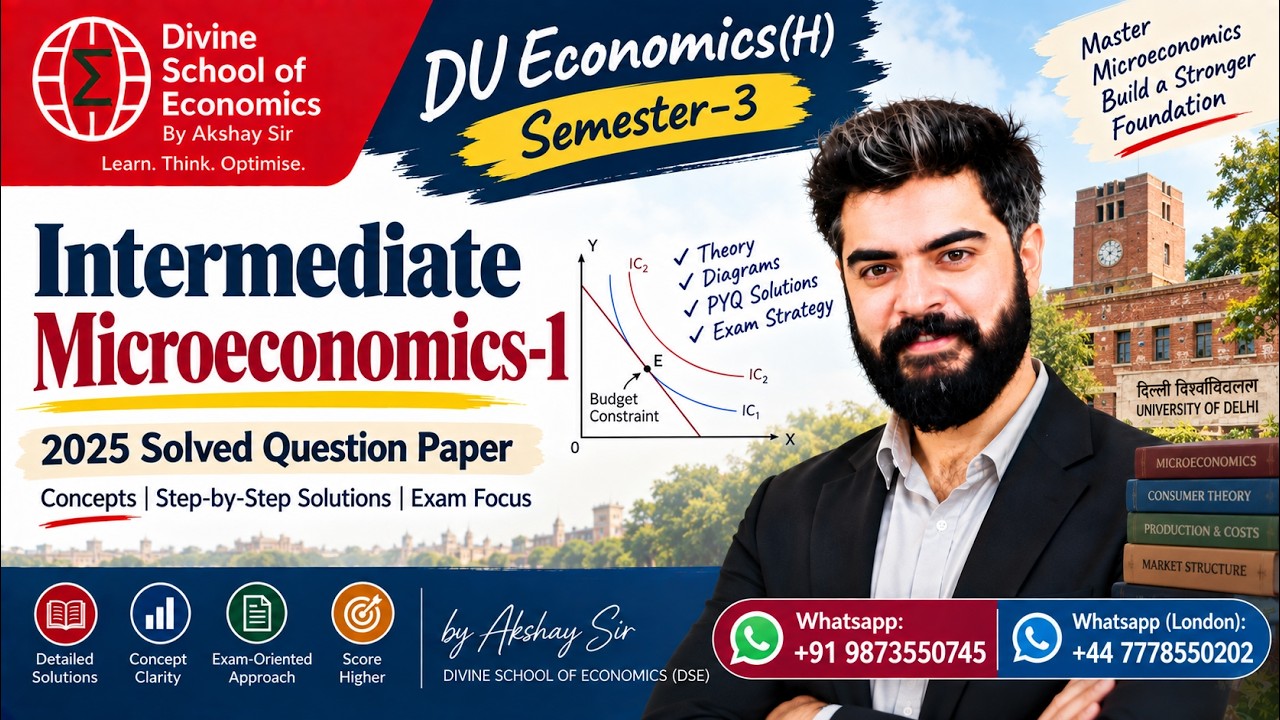
DU ECO(H) · SEMESTER 3 · INTERMEDIATE MICROECONOMICS I
Build statistical understanding through worked examples.
DU BA(H) · SEMESTER 1 · INTRODUCTORY STATISTICS
Begin with simple regression, then explore the multiple regression model.
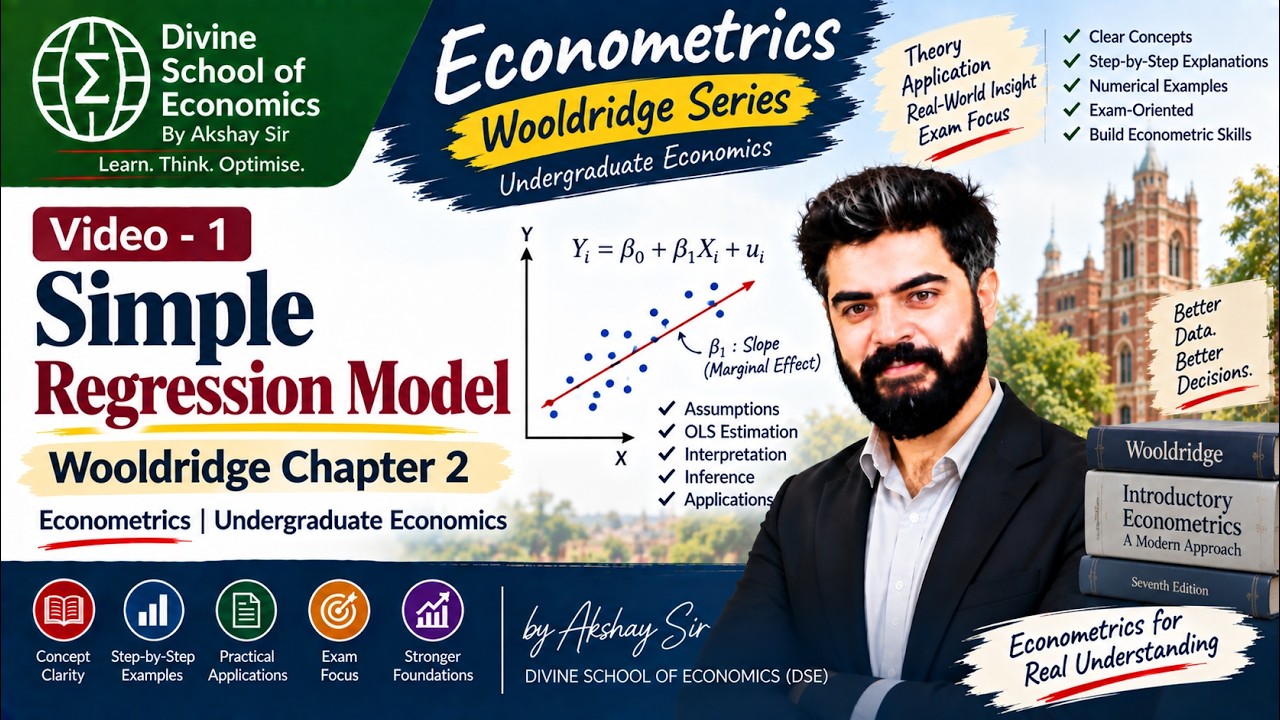
WOOLDRIDGE · CHAPTER 2 · SIMPLE REGRESSION
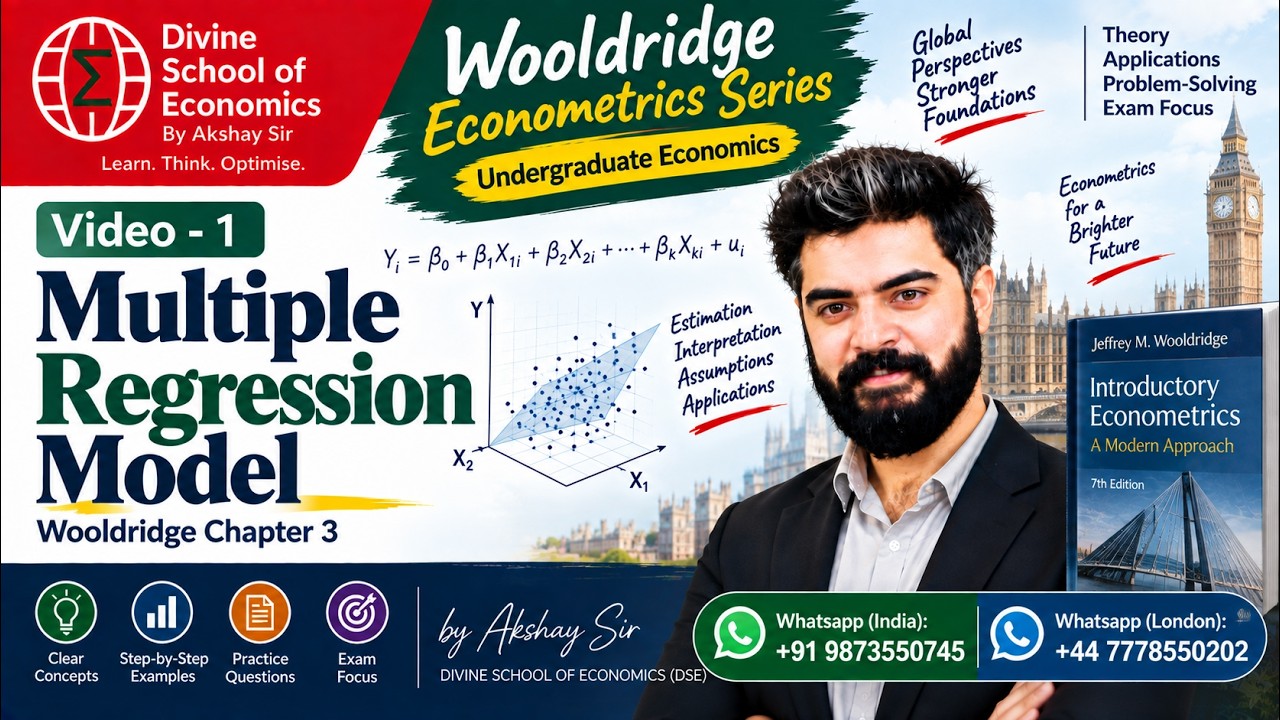
WOOLDRIDGE · CHAPTER 3 · MULTIPLE REGRESSION
Work through the three practice tutorials in order.
CHAPTER 2 · PRACTICE TUTORIAL 1
CHAPTER 2 · PRACTICE TUTORIAL 2
CHAPTER 2 · PRACTICE TUTORIAL 3
Explore linear regression for undergraduate Economics.
GUJARATI ECONOMETRICS · LINEAR REGRESSION · VIDEO 1
04 / BEFORE YOU BEGIN
Yes. Share the module outline, reading list and the topics you need help with so that we can plan relevant support.
Yes. DSE Flex is suitable for focused 1:1 support. A longer plan can be discussed if you need help across a paper.
Selected advanced topics can be discussed using your syllabus. Send the module outline first so that we can confirm the fit and scope.
Bring a topic or question you would like to understand better, alongside your syllabus and learning goals.
Use “Request Your Free First 1:1 Lesson” to prepare a WhatsApp message. Share your university, module and time zone so we can discuss the support you need and arrange a suitable lesson time. Choose an office and press Send in WhatsApp.
Bring your module outline and a topic or practice question. Discuss your goals and current difficulties with Akshay, then work through a suitable concept or part of a problem to explore the teaching approach and identify useful next steps. Confirm a suitable time and joining details beforehand. Your first 1:1 lesson is free.
Yes, you can enquire about live online lessons from your own time zone. Share your city or time-zone name, preferred dates and local times, and any exam deadline. Availability is confirmed individually before booking; check the agreed time in both locations, especially around daylight-saving changes.
LET’S START WITH YOUR GOALS
Your first 1:1 lesson is completely free. Share your university, module and time zone so we can discuss the support you need and arrange a suitable lesson time.
Request Your Free First 1:1 Lesson